
Location
The island stands at the center of the Eastern Mediterranean with close links to Turkey, the Middle East, and North Africa.
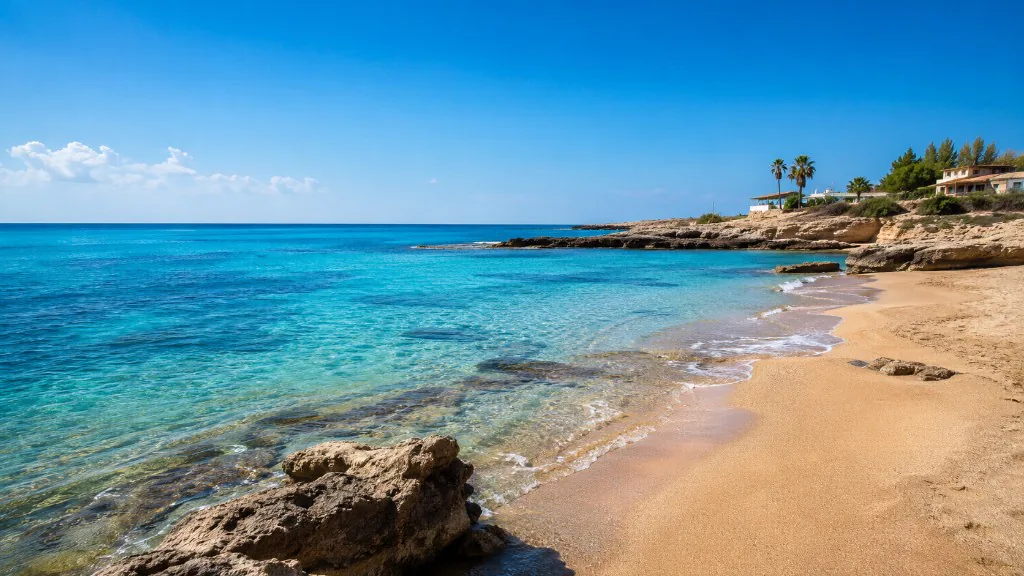
Cyprus, an island in the Eastern Mediterranean, is the third-largest island in the region after Sicily and Sardinia. It lies about 70 km south of Turkey, 100 km west of Syria, 370 km north of Egypt, around 170 km from Lebanon and Israel, and roughly 950 km from Greece. The island covers 9,251 km² in total. Of this area, 3,355 km² belongs to Northern Cyprus and 5,896 km² to Southern Cyprus.
Island Area
9,251 km²
Northern Cyprus
3,355 km²
Capital
Nicosia
Established
15.11.1983
The island stands at the center of the Eastern Mediterranean with close links to Turkey, the Middle East, and North Africa.
Since 1974, the island has been divided into two separate administrations: the TRNC in the north and the Greek Cypriot Administration in the south.
A mild climate, short travel distances, and student-centered urban life make daily routines easier and more practical.
Between 1963 and 1974, Cyprus experienced a long period of tension between the Turkish Cypriot and Greek Cypriot communities. These tensions gradually developed into open conflict and violence.
Following Turkey’s military intervention in 1974, the island was divided into two separate administrations. The Turkish Republic of Northern Cyprus is in the north, while the Greek Cypriot Administration controls the south.
The two sides are separated by the line known as the Green Line, which runs through the capital, Nicosia. The Turkish Republic of Northern Cyprus was officially founded on 15 November 1983.
The Turkish Republic of Northern Cyprus is approximately 160 km long, and its widest point is about 65 km. Its total area corresponds to roughly 36% of the entire island.
Administratively, Northern Cyprus is divided into five districts: Nicosia, Famagusta, Kyrenia, Guzelyurt, and Iskele. Its main settlement centers are Nicosia, Famagusta, Kyrenia, Guzelyurt, Lefke, and Iskele.
Cyprus has a typical Mediterranean climate. Summers are hot and dry from June to September, while winters are generally mild and rainy from November to March. Spring and autumn are softer and more pleasant seasons.
The annual average temperature is around 20°C. During summer, temperatures are often above 30°C, while in the coldest months, such as January and February, they are around 10°C.
After the first rains in November, the island’s natural landscape becomes vibrant again, with green cover, tulips, daisies, and cyclamen standing out across the countryside.
From May to October, the average sea temperature is around 24°C. Coastal areas are especially active, with restaurants, cafeterias, bars, and water sports facilities.
The population of the Turkish Republic of Northern Cyprus has varied across different census periods, but the urbanization rate is relatively high and a significant part of the population lives in city centers.
Turkish is the official language. English is also widely understood and spoken. The telecommunications infrastructure supports international communication through phone and internet services.
The electrical system is 220/240 volts, and the plugs follow the British standard.
Visitors can enter Northern Cyprus with any passport. A visa of up to 3 months is generally issued on arrival; longer stays may require an application to the TRNC Immigration Department.
Children up to the age of 16 may enter with their parents’ passports. There is no vaccination requirement.
Tourists are generally not subject to customs duties for personal belongings and basic food items. However, it is illegal to take archaeological or historical artifacts out of the country.
The official currency in Northern Cyprus is the Turkish Lira. British Pounds, US Dollars, and various traveler’s cheques are also generally accepted by banks, hotels, and exchange offices.
Access to Northern Cyprus is largely provided through Ercan Airport. There are direct flights from several Turkish cities, including Istanbul, Izmir, Ankara, Adana, Dalaman, and Antalya. Flights from other countries usually connect through Turkey.
By sea, ferry services operate year-round between Mersin and Famagusta, as well as Tasucu and Kyrenia. During high season, additional services may be planned from places such as Alanya, Antalya, and Anamur.
Traffic in Cyprus flows on the left, as in the United Kingdom. Roads are generally safe and in good condition. Vehicles entering the island must have valid local insurance.
Taxi fares are usually reasonable even though meters may not always be used; it is still recommended to confirm the fare before the trip. Intercity buses may run frequently during the day, but services tend to reduce in the evenings and on weekends.
Rental cars can be obtained from hotels and rental companies in city centers. An international driving license is generally sufficient for renting a car.
Northern Cyprus offers a wide range of accommodation options, from five-star hotels to apart-hotels, holiday villages, campsites, guesthouses, and rental villas. Most tourist facilities are concentrated around Kyrenia and Famagusta.
Shopping includes both European brands and local handicrafts. Gift shops often offer copper, silver, bronze products, backgammon sets, hookahs, and other local goods.
Most shops are open between 08:00-13:00 and 15:30-20:00. Prices are generally fixed, and bargaining is not especially common.
Nightlife is not extremely intense, but it becomes livelier in coastal towns, bars, restaurants, and around large hotels. During summer, the Kyrenia Harbour area is one of the most active places.
Traditional customs and hospitality remain strong in the Turkish Cypriot community. Weddings, religious holidays, circumcision ceremonies, childbirth, and school beginnings are all visible parts of social life.
Coffee, sherbet, and various forms of hospitality have an important place in daily culture. Respect for older people and careful treatment of guests are among the notable social habits.
Cypriot cuisine combines Mediterranean and Turkish culinary traditions. Seftali kebab, molohiya, halloumi, nor pastry, pilavuna, a wide variety of meze, preserves, compotes, and local drinks are among the best-known flavors.
In handicrafts, Lefkara embroidery, silk work, plant weaving, and other region-specific productions stand out.